Monday, November 7, 2022

Dutch Split-Tailed Coif

   ***

I was mid write-up on an upcoming post for an outfit inspired by the Dutch folk hero, Kenau Simonsdochter Hasselaer, when I realized this coif needed to be it's own post.

 
(Please excuse the weird, super wide-angle lens of the iPhone's reverse view)

Let me back up a bit...

As part of my research into my Keanu inspired outfit I hit a stumbling block as to what sort of head covering to make. 
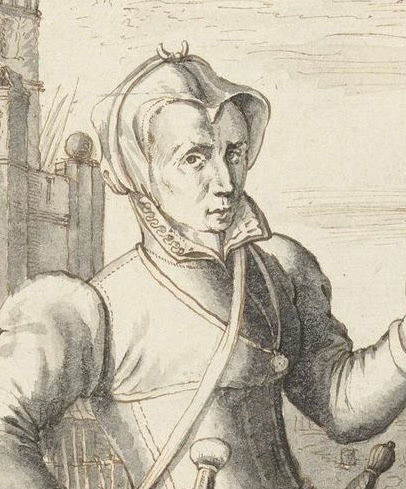
She is featured in multiple paintings, etching and pamphlets. While the pose and styling remains fairly consistent across most images, there is one significant point of difference: the coifs (caps? veils?).


Broadly these fall into two categories: 

1) Tails tied over the head...

2) Tails down...


I believe both are representative of a Dutch style that really flummoxes me: the tailed veil.

What exactly is going on here?

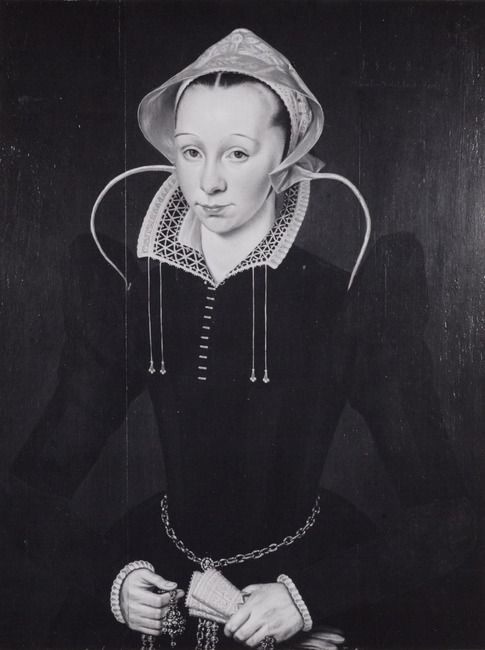
Let's consider the second version with the loose tails (assuming the first is the same but with the ends tied over the head). This style of head-covering is fairly typical of mid to late 16th c. Dutch fashion.

Pieter Jansz Pourbus, 1550s

Although to looks like a close fitting coif, it's more probably a very intricately folded veil which evolved from earlier styles.

Now, I'm going to say right out the gate that I have no idea how this was achieved. Zero. None.
I've tried folding your standard rectangular veils and couldn't even get close. I'm not sure if I have the shape wrong or if the fabric just isn't fine enough (and probably both) but it's a non-starter.
There's no way I can (currently) make a rectangular, tailed veil work.

So instead let's take a detour further back in time (just for fun).

The version with the ties above the head is not too dissimilar to the "tailed caps" of the mid 15th century.


This style is fairly popular with reenactors and there are several suggested patterns for its construction. I'm not sure that I'm totally convinced by any of them, but I decided to try a couple and compare the results...just to see if they sparked any ideas.

The first is basically a large trapezoid.
(Which didn't quite fit on my cutting board, but the bottom edge is straight across).


It's a single layer of fine 2.8oz linen. The on-grain edges are turned with a narrow folded hem. The bias edges have a rolled hem.

The narrow side frames the face and the longer points are twisted and tied around the head.
The front is also lightly starched (about 4-6" along the narrow edge).


The result is fun, but the angle around the face doesn't quite match the period images (and in fact seems to fall in the opposite direction)
But it's an attractive shape and can be worn in multiple different ways.


Next is a long rectangle with a large 'V' cut out of one end.


Again, the tails are twisted and tied on top of the head.
The front section is also starched (a bit more heavily this time) as well as being folded down the middle. This helps create the heart shape that frames the face.


It still doesn't quite mach the mid 15th c. silhouette above, but it is a closer match for the later 16th c. styles (and so more in the ballpark for what I'm ultimately aiming for).


This can also be pinned to the under coif to create different silhouettes.


And of course it can also we worn down as a long, split-tailed veil.


While both patterns (and all the variants) are super fun to wear I'm still not 100% convinced by either version, if only for the inefficient use of fabric (and resulting wastage).

So I'm back to square one. 
Really, I'm in a position where I'm fairly certain that anything I do will be wrong (historically) so now it's just a matter of picking something that works aesthetically and/or theatrically.

So I start thinking about abandoning the veil and making a coif. 
Conveniently, this is also when I discover this image:

Motivated reasoning aside, the image does seem to suggest gathers at the nape of the neck and the tails coming off the front brim (rather than from behind).

It's not a total leap. There are early 17th c. coifs that feature long tails, though they don't particularly lend themselves to be twisted in this style.

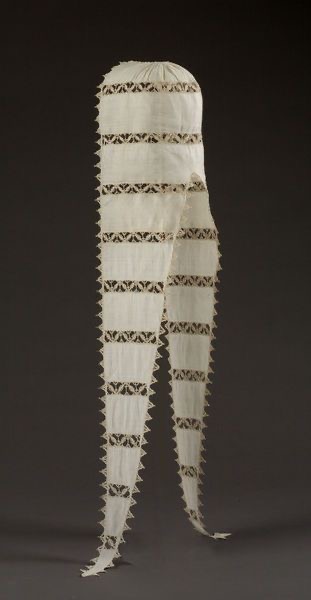

Still, perhaps it's not totally unreasonable to think there may be a hybrid style, especially when looking at the late 16th to early 17th c. images that seem to indicate gathers around the side of the face...which might suggest something other than a folded veil.
(Hello again, motivated reasoning! I missed you! Come, pull up a chair. Stay a while...)


So with that in mind I decided to adapt the late 16th/early 17th c. coif pattern I've made up previously.


My plan was keep the most of the current shape, but then extend the front side sections into tapering tails.


(NOTE: This pattern is given in centimeters, the previous patterns are in inches)

The linen pattern is cut in light weight linen. Wherever possible a tread is pulled so that the all edges are cut exactly on the grain (basically everything except the tapered, diagonal edge)


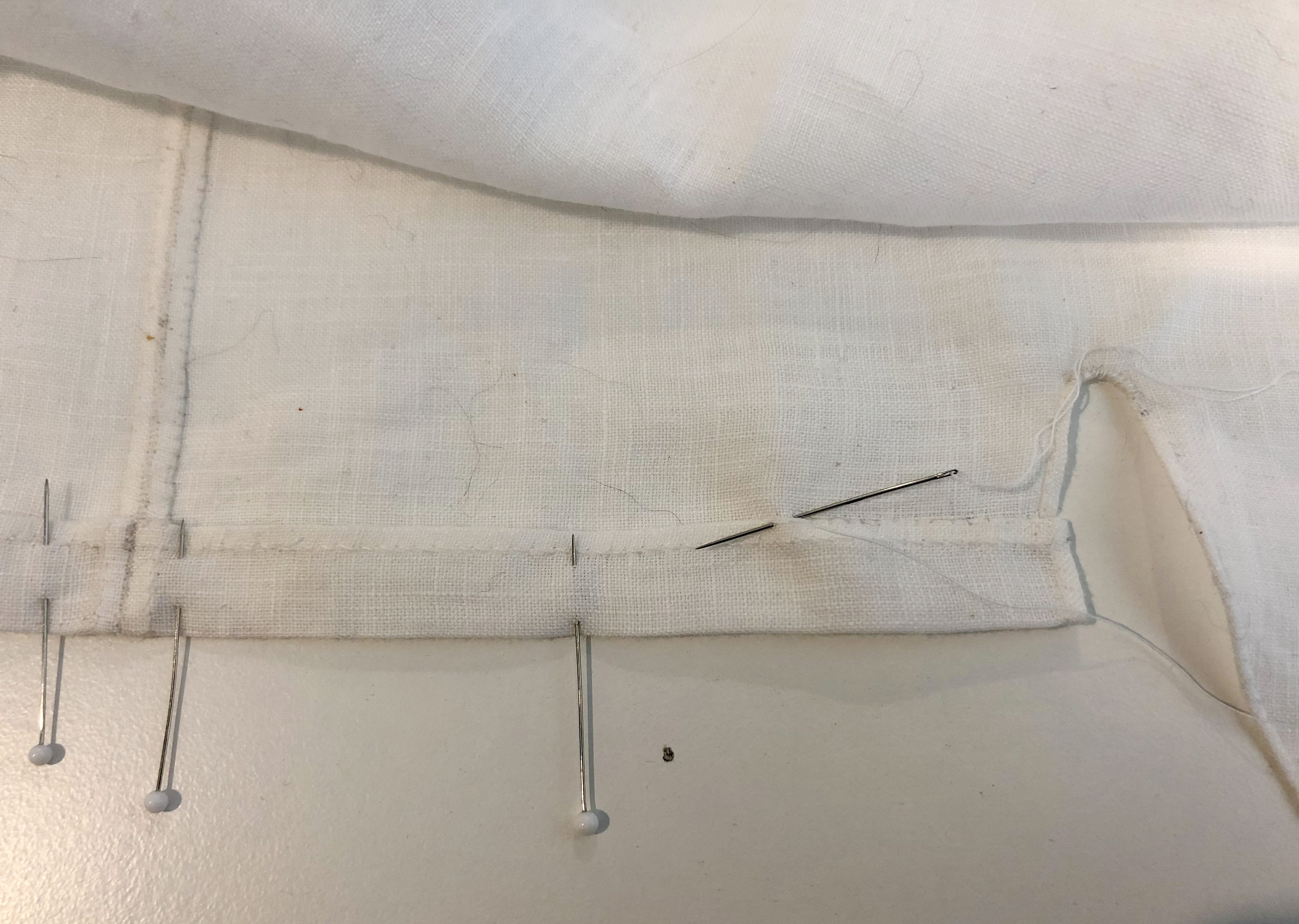
All edges are then finished with a narrow turned hem (except the diagonal egde, for which I found it easier to to do a rolled hem) 


Then back edges are whipstitched together (right sides facing)


The the bottom. back edge is folded over and stitched down to create a lacing channel.


Next, the "hole" formed by the cutout on the top of the head needs to be closed. The is done by running a series of tiny cartridge pleats along the longer edge and then whipstitching them to the narrow front edge. 


The coif is now complete!


Now it's time to shape it...

First, the front section is starched, folded down the middle and pressed to create a heart shape to frame the face.
(The coif is pressed inside out, so that when flipped the top springs outwards from the central fold)


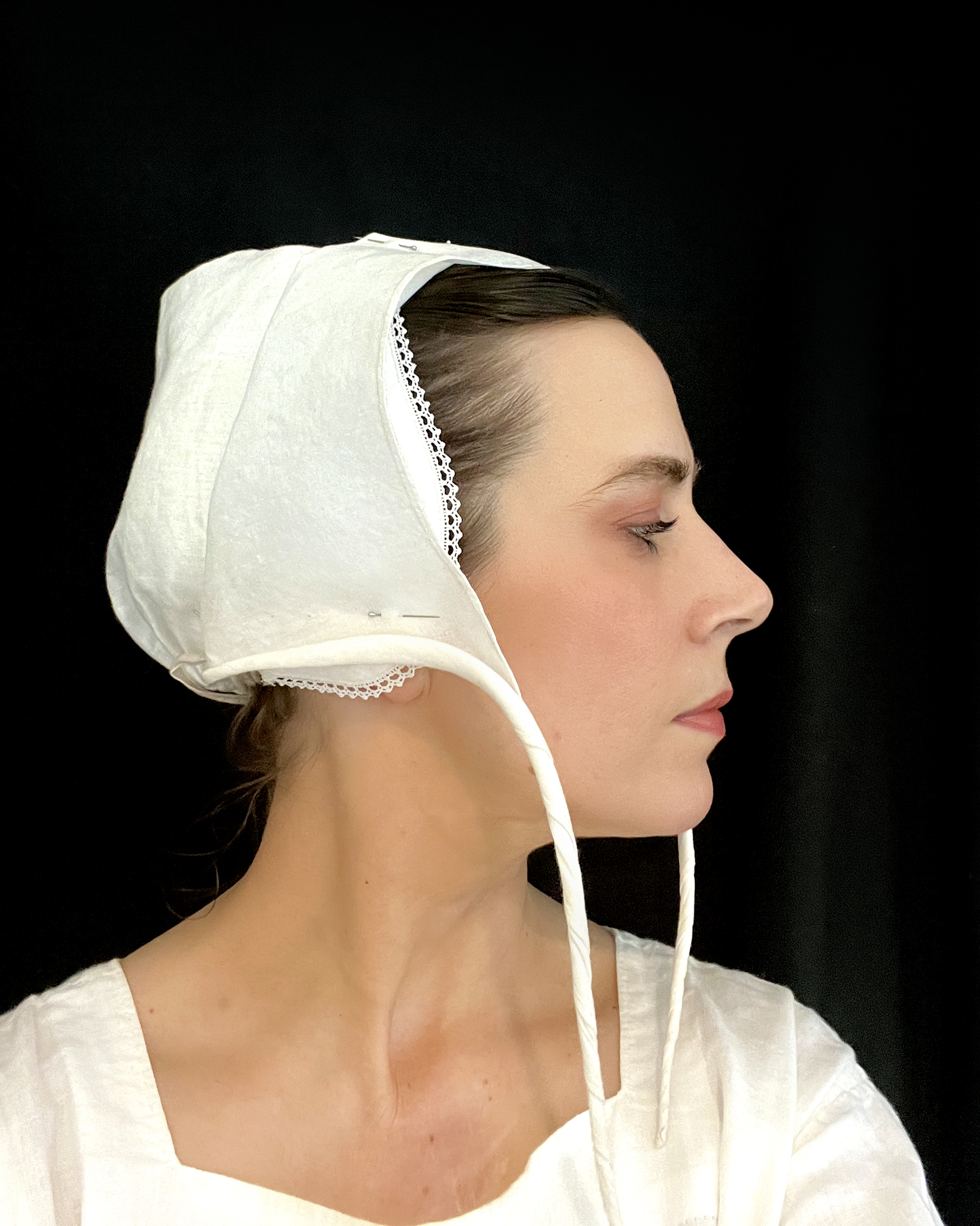
Next, the tails are twisted to form tight "barbels" (as they are lovingly referred to on the Elizabethan Costuming FB Page).
It's a tad difficult to see, but the brim is also folded back over itself (just where the ties wrap around the head) in order to encourage it to spring out and upwards.
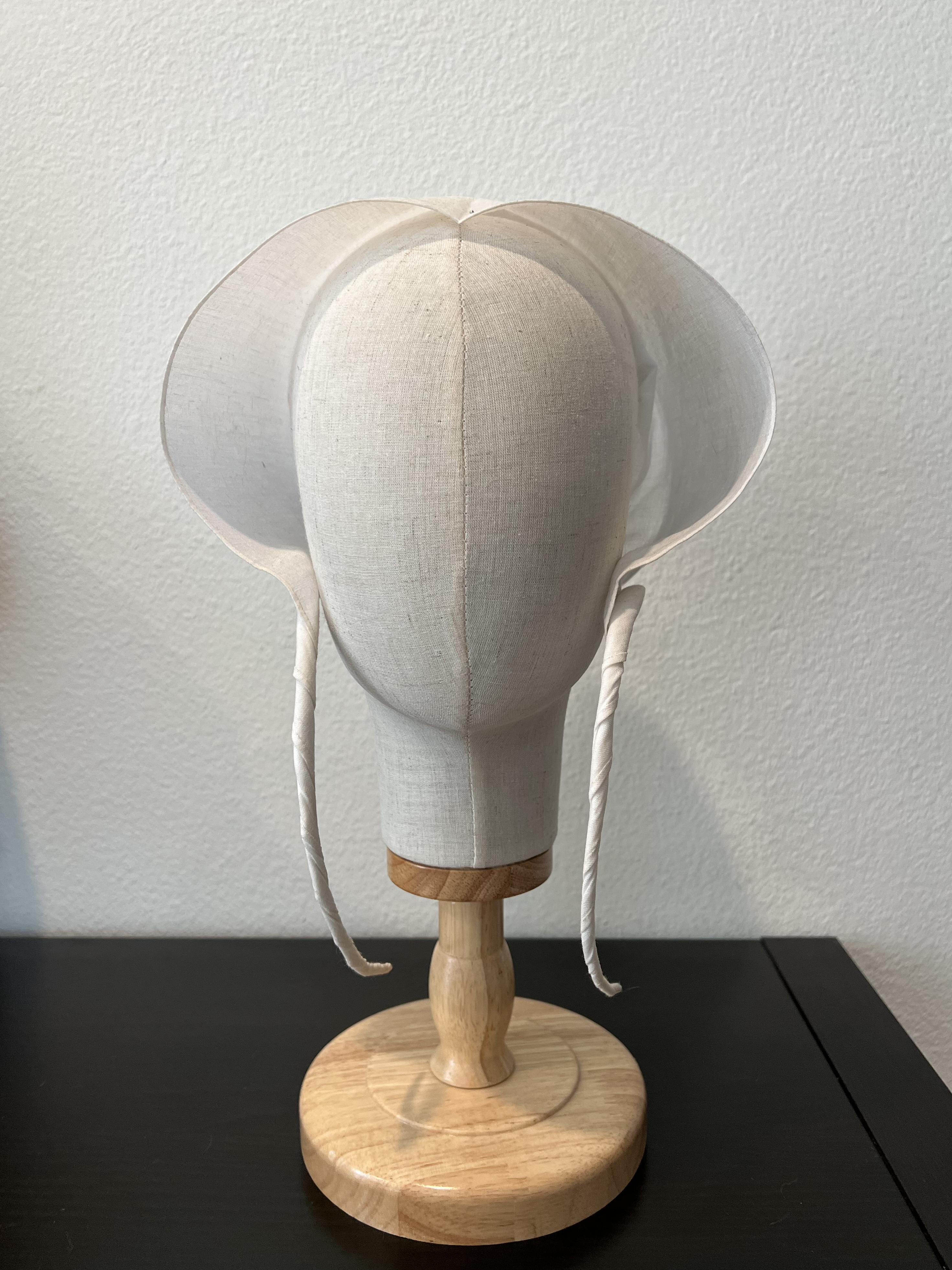


The cap can then be pinned to create subtly different shapes.

Flat across the top:


Heart shaped: 


Or even that baffling style where the tails form a ring.


And....I think that's about it!
Phew! 
For what was meant to brief side post, this ended up pretty packed.

I should also note that all of the above styles are worn over a close fitting coif...


...but for the most part I didn't use my ear irons (or 'oorijzers'). 


(Oooh...look at her, she's a baby!
Back when you still took photos with cameras.)

Usually I use oorijzers to help stabilize my starched caps and veils, but found that most styles worked well enough just pinned to the under coif.

I did however use ear irons for these two images. 
(While I found they did help anchor the coif they were not strictly necessary to achieve a similar look. Having said that, I will probably still opt for them when wear this style out of doors and need to account for the wind.)


Final thoughts: After all that I still don't think I've gotten much closer to figuring out what's really behind these styles, but it was fun and informative to compare the various shapes and silhouettes.  

At the very least I've got a couple of good options for my Keanu outfit...which was, after all, the whole point.

Hopefully I can get the full post up soon!

(EDIT: And HERE it is!)


***

Resources & Materials

Pattern:  
-Veils: self drafted/draped 
-Coif: The Marquess of Winchester Coif #4 (with significant edits)

Fabric:
-White linen (2.8oz) from WM Booth Draper

Trim and Notions:
-Linen tape (1/4")  for lacing from WM Booth Draper

Thread:
-White cotton thread (silk finish)

Sunday, November 6, 2022

Kenau Simonsdochter Hasselaer - The Inspiration

 ***

Like most of my projects, this one is a couple of years in the making. And it started with this image.


It first came to my notice when I was planning my blue Trevelyon inspired gown. At the time I was looking for reference of other similar long sleeved gowns or kirtles.


At first I didn't think much of the etching, other than noting that the lady in question looked particularity badass. 
But then I started to come across more and more images of similarly posed women, usually holding a spear and armed with a plethora of other weapons. 


At the time I assumed the imagery was strictly allegorical. 
I'm embarrassed to say that it never occurred to me to look into what was actually written on the etchings. If I had, I would have discovered that all images are of the same woman: Kenau Simonsdochter Hasselaer (1526–1588).

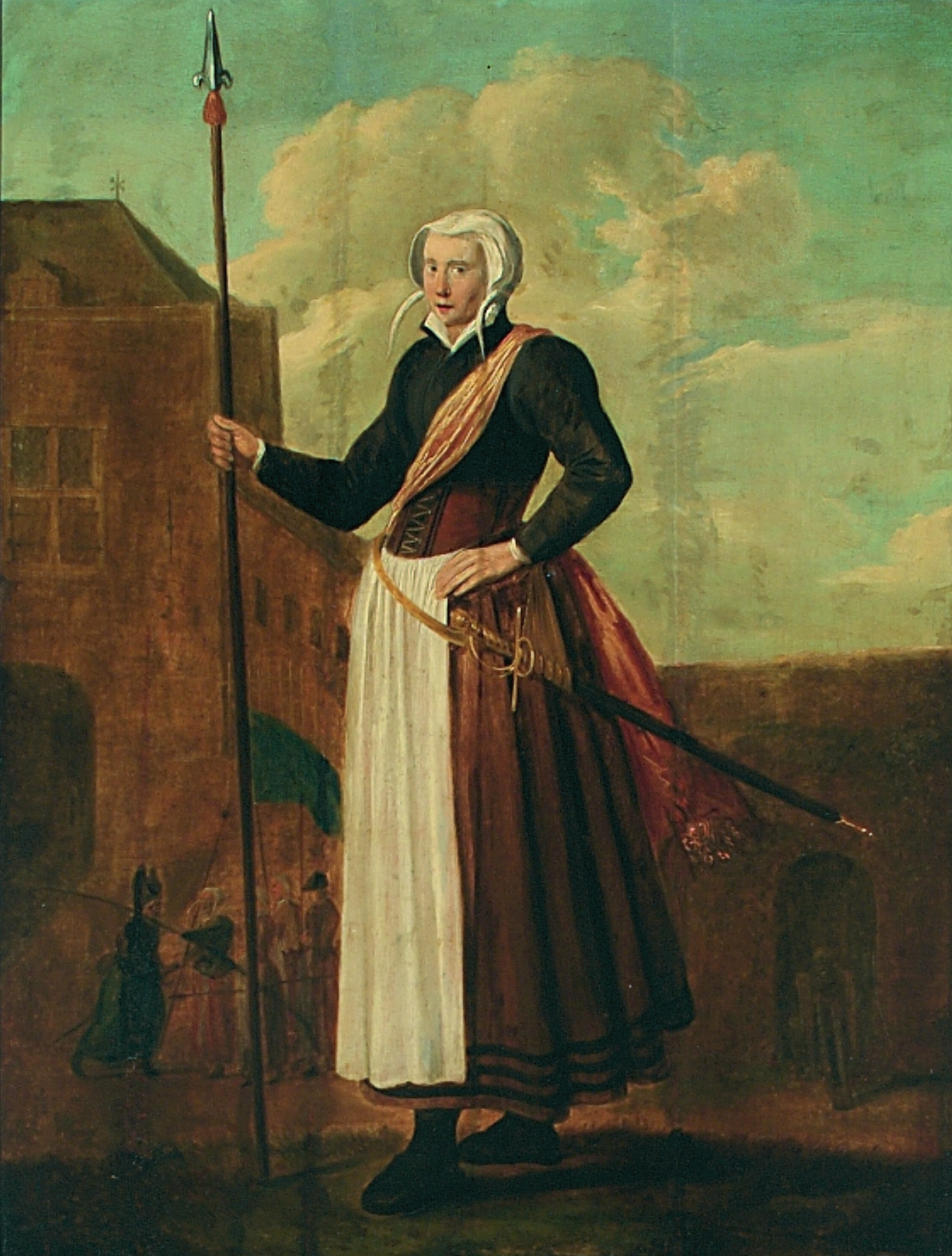
 Portrait of a woman from the Hasselaer family, 16thC. Assumed to be Kenau

As far as I can tell from the English sources, Kenau is a Dutch folk hero who became legendary for her actions during the 1573 siege of Haarlem.  
In the years following the siege, her renown grew and her (probable) role as one of the citizens maintaining the earthworks expanded to a defender throwing incendiary devices from the battlements, and ultimately to that of a soldier leading an army of 300 angry women into battle against the Spanish!

(While the tale is almost certainly embellished, the real Kenau was probably killed by pirates in the late 1580s…and so she still remains very badass in my books!)


After looking into the history and expansion of her legend I really wanted to return to the image that first sparked my interest and create an homage to Kenau Simonsdochter Hasselaer. But I wasn't sure if that image could be trusted...

While many of portraits and etching of Kenau mention the year 1573 (the year of the siege), most date to significantly later. Her popularity seems to have peaked around the centenary celebrations in 1673 and so many images date to the middle of the 17th century and later.

One of the earliest images I could find is this painting by an anonymous artist which is currently believed to date from around 1580-1609 (perhaps painted within her lifetime or shortly after her death).  An etching based on this painting dates from 1740-74.


She wears a black, fitted gown and a classic Dutch split-veil. She also appears to be closer to her actual age.
I really like this version of Keanu and it's one I might return to in the future.

The next earliest image is a fragment of a tapestry that is also dated to the 1580s or 90s.


I have to say I'm significantly less convinced by this image. The coifs seemed to be handled oddly and there's something about the woman on the right's pose with the pistol that feels somewhat 19th c.
The one thing it possibly has going in it's favour is the rendering on the partlet (but more on that later...)

This image also features the classic Kenau stance: three-quarter front pose, hand on hip, holding a spear out to the side.
My guess is that this is based on an already established image of Kenau and therefore dates to significantly later than 1580 (or is based on a lost original from the same period).

Either way, this seems to the archetypical pose and one that is seen again and again.


Another element that later images of Keanu all seem to have in common is the colour pallet. She is almost always is depicted in a red (often rust) kirtle and a black...
What exactly? 
A gown? Partlet?  This is where things get interesting...

What is the black garment Keanu wearing in these later images? 
As far as I call there are three distinct camps:
    1) A black partlet worn over a gown or long sleeved kirtle
    2) A black long sleeved gown, pulled back to show the underskirt or kirtle
    3) A black, long sleeved partlet

Now, I felt that a long sleeved partlet was probably the least likely option, but at the same time it was something appeared (or seemed to appear) in multiple images.
Why was this?
Were 17th c. artists misinterpreting an earlier style: repeating the same mistake over and over again as different artists copied each other (in a sort of visual game of 'telephone').  Or were they projecting a later style backwards?
I really can't say.

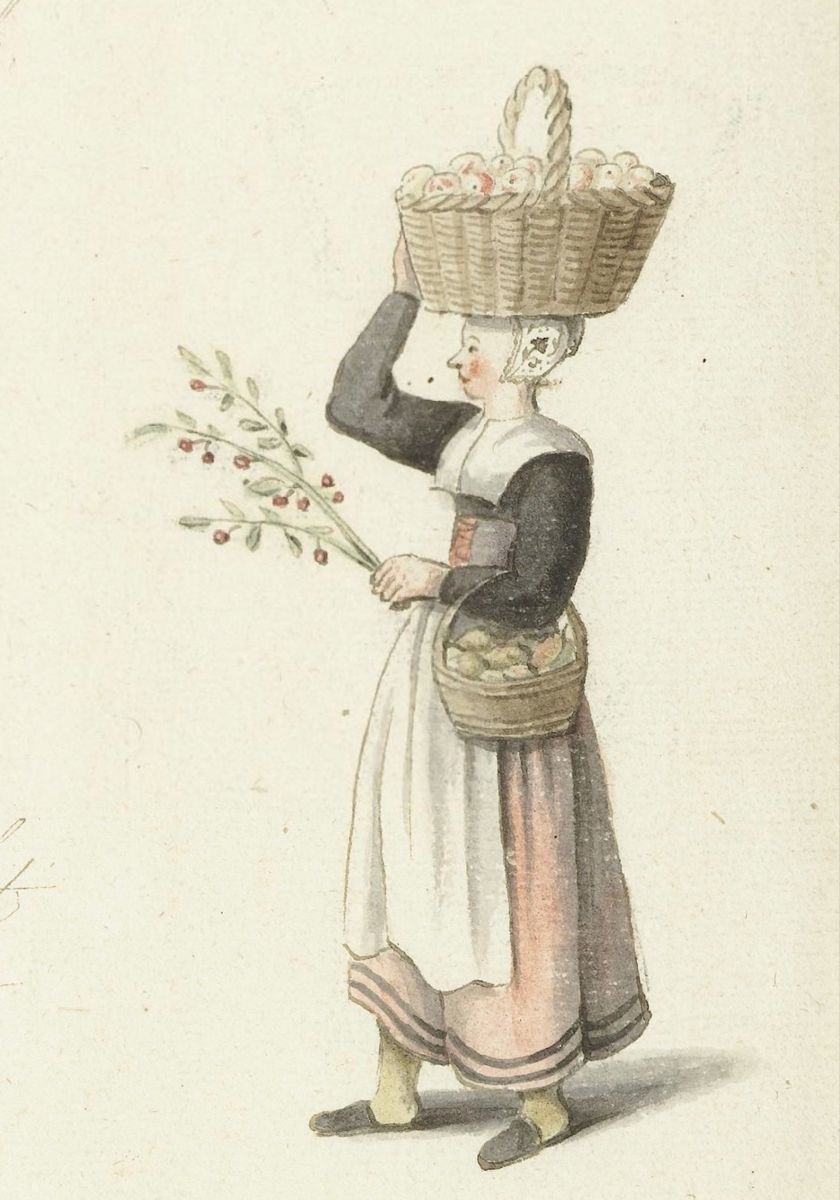
It wasn't a style I'd come across in any other 16th century images, but as I broadened my search I did start to see something similar in 17th century ones, most notably in the watercolours of Gestina ter Borch.


(NOTE: I actually ended up re-styling my Kenau outfit after these drawings. Photos of which can be found HERE. )

Now, it should be mentioned that there is still the possibility that these are actually pin on sleeves. However, the way these images are rendered makes me think that they are meant to represent integral sleeves on a sort of short coat or partlet. 


It's also looking more and more likely (to me) that this is a uniquely 17th century garment, especially since I had yet to find anything in earlier sources.

Until I came upon this Bruegel...


...BUT it's not what it seems.
It's not an early to mid 16th c. painting by Pieter Bruegel the Elder (1525-1569) but a later re-working by his son, Jan Brueghel (1568-1625). It dates to about 1600 and is a pastiche of his father's earlier peasant paintings.

So right now I'm working under the theory that there may actually have been been some sort of short Dutch jacket in the early to mid 17th century, and so any images of Keanu supposedly wearing one in the 1570s are likely to be extremely anachronistic.

And yet...

I WANT TO MAKE ONE.

So even though I think a black fitted gown is a much better choice for the historical Keanu, I opt for the more iconic later look. Long sleeved partlet and all…


Now this post has already gotten WAY too long, so I’m going to save the actual Dress Diary for a later post. 
(Which can be found HERE)


EDIT TO ADD:
So after all that deliberation and nearly a YEAR after finishing the gown I came across this image from 1558 which seems to show a short-ish jacket (with matching cuffs and collar)


So now I’m back to not knowing what the heck is going on…

Thursday, April 21, 2022

Rust Brown Kirtle

***
Another mini update!
As the world opens up again (before potentially heading towards another surge, but that's another matter...) events are now a thing! 
After two years my local Renaissance Faire has opened its doors again and so I decided to take advantage of a rare weekend of cool weather to bust out a new outfit: a rust wool kirtle that I completed during lockdown.


The inspiration for this specific look is taken from a 1654 watercolour by Gestina ter Borch (above), but the real impetus for making the kirtle in the first place was a painting of Kenau Simonsdochter Hasselaer, a Dutch folk hero from the siege of Haarlem (1572).


In trying to research the the odd sleeved-partlet type garment she is wearing I came across the (much) later ter Borch image and absolutely fell in love with the styling...in particular the gathered up skirt and green stockings! 


So with most of the accessories already in hand, it was extremely easy (and very fun!) to restyle the kirtle for the 1650s...though I still think the overall look still reads as 16thc.

The skirt is pulled up over a low slung leather belt with a red ribbon tied around the hips. I ran out of ribbon to make a tie for the hat --as seen in the watercolour-- but I just ordered some additional yardage and so may take new photos in the future to more closely approximate the look.
In the meantime I think the overall effect is super cute!


I still intend to do a more in-depth post when I write-up and photograph the Kenau look (as well as add the missing third row of trim to the skirt).  I don't want this page to just turn into a photo gallery, so hopefully this will just serve as a preview until I get the full post up!

(EDIT: That post can now be found HERE)


***